


A short trip down memory lane a few weeks ago had this newsletter thinking about neuroplasticity and what constant dopamine-chasing behavior is doing to our brains. This is not a new phenomenon, but I do believe we have lost sight of the true harm that new technologies are doing to brains whose key evolutionary touchpoints include using stone tools and the use of fire.
Anyone who has followed the rise of AI knows that a lot of its progress is being driven by people who are myopically focused on the financial returns, regardless of the actual human cost. But the rise of AI is a mere symptom of the larger problem plaguing Americans - one that will accelerate underlying fissures already actively harming society.
We’re Already on Shaky Ground
This newsletter has waxed poetic on the extremely online state of the union before, and things have not gotten better since.
Our echo chambers have deeper echoes. Attention spans have gotten to the point where 6-second bumpers feel like 60-second TVCs. Platforms continue to sow division (and much worse) with impunity thanks to 90s-era deregulation. When our phones aren’t killing us in car crashes or turning us into hunchbacks that would make Quasimodo cringe, they’re rotting our brains. We’re not starting from an excellent position, dear reader.
And what Covid did to the social contract (spoiler alert: hastened its demise), AI will do to our malleable gray matter.

We’ve Been Sleeping Through the Alarm
I would love to say that the alarm has just started ringing and we need to answer its call. That would be as accurate as the financial projections for AI data centers.
The truth is, every new technology brings its detractors. But today’s reality is that AI is not a new technology - tech firms have been utilizing artificial intelligence through one form or another for decades. And we’ve already felt the deleterious effects of it.
There’s the recent case against Meta and YouTube, in which a jury found both platforms liable for their addictive nature - which is not accidental, but by design. Take the harm done to the plaintiff in the Los Angeles case and multiply it by the amount of young users on these platforms and you can understand why the personal injury approach for these cases has followed Big Tobacco - and why that approach is beginning to bear fruit.
But the recent cases are only the latest chapter in the saga of the internet melting our brains. The true impetus of this post was a seminal Atlantic article titled “Is Google Making Us Stupid?” from the extremely quaint time of 2008.
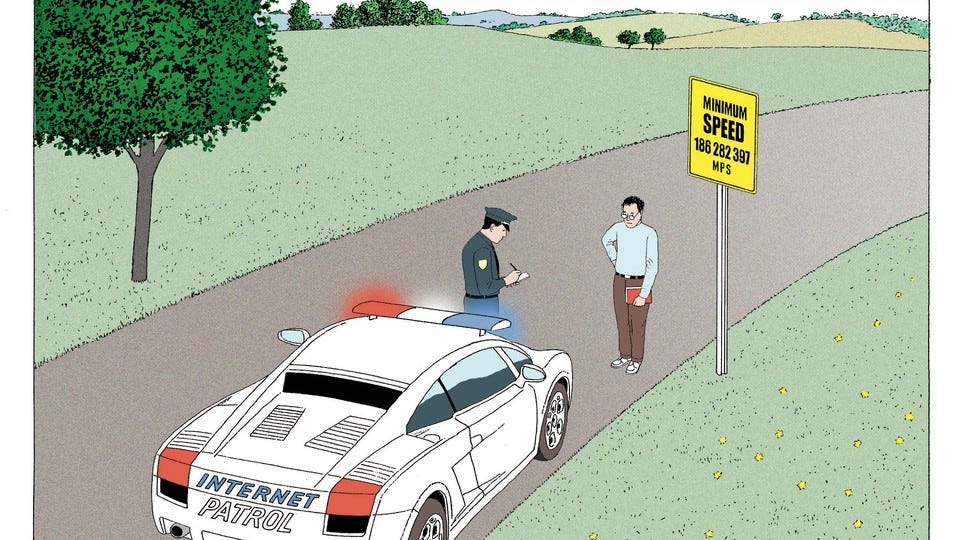
The article is worth a full read, but for those who have already fallen victim to its conclusions, one particular passage stands out:
“We are not only what we read,” says Maryanne Wolf, a developmental psychologist at Tufts University and the author of Proust and the Squid: The Story and Science of the Reading Brain. “We are how we read.” Wolf worries that the style of reading promoted by the Net, a style that puts “efficiency” and “immediacy” above all else, may be weakening our capacity for the kind of deep reading that emerged when an earlier technology, the printing press, made long and complex works of prose commonplace. When we read online, she says, we tend to become “mere decoders of information.” Our ability to interpret text, to make the rich mental connections that form when we read deeply and without distraction, remains largely disengaged.
That deep thinking that pops when we’re engaged in offline reading is crucially missing - and its void spans generations. The brain is highly malleable regardless of stage of life. So while “digital natives” (an antiquated term Gen Xers and Boomers used to call us Millenials when we entered the workforce and chose IM over picking up the phone) may be more cooked than their older counterparts given their exposure to this technology during crucial brain development, just take a look at the cross-section of society on their phones during your commute to get a sense of how pervasive the Google era has become.
Gen AI Will Catalyze Our Turn Away From Critical Thinking
One of the consequences of Google making us stupid is buttressed by one of the least-talked-about crises facing America today - one out of five Americans is functionally illiterate. That means they can’t compare and contrast information, paraphrase, or make low-level inferences from text. And the US continues to slip in its literacy rates, which further entrenches a lack of critical thinking at a time when the country is gasping for it.
But that is the most extreme data point - the reality is that generative AI usage has already begun to mold our brains in much more subtle ways than can be picked up in an OECD report. I believe professor Ioan Roxin has put it quite succinctly (and in a quintessentially French way): “I don’t think it’s an exaggeration to say that they [gen AI tools] are driving intellectual, emotional and moral mediocrity on a global scale.”
Coming from a foundation of functional illiteracy, Google reshaping information ingestion, and social media addiction, la course à la médiocrité will only quicken in the generative AI era. The overreliance on generative AI tools amongst knowledge workers (not to mention the wider American population) for everyday tasks will lead us down a path we’ve tread for ourselves, only faster. Akin to how Covid shredded what little was left of the social contract, gen AI will do the same to critical thinking (or, again, what’s left of it in a country that elects *points around at Congress and the executive branch* these imbeciles as our representatives.)
So What’s a GenAIer to Do?
American desk jockeys are in an unenviable position: AI is the future, and it needs to be utilized in workflows to drive efficiency and cost savings for our corporate overlords. At the same time, overreliance on the technology is not only a good way to become an NPC in Wall-E, but also a good way to become redundant once leadership figures out how to dupe you as an agent in Copilot.
To be clear, you need to be using this technology - to quote the inestimable Reese Bobby, if you’re not using AI at work, you’re last.

But you don’t need to cede all of your critical thinking to it. Client services (particularly advertising) are low-information environments; clients pay major holdco agencies a lot of money to steward their media dollars with fuzzy briefs and evolving business KPIs. Generative AI alone can only do so much in this kind of ecosystem.
While it can (and does!) drive efficiencies of various workstreams, its output is nowhere near client-ready in this newsletter’s experience. Whether you want to call it massaging, tweaking, or some other synonym, this author can tell when something has been Ctrl+C’d and Ctrl+V’d from ChatGPT and what hasn’t. And so can most clients.
If you want to remain relevant in the AI era, it’s not about dumping your thought process onto the models and calling it a day - it’s about getting the most out of the tech while still maintaining your critical thinking skills that drive the final outputs to the next level.
Grab Bag Sections
WTF America
I really really try to avoid politics on this newsletter. I’ve played that game - from working on campaigns, to padding Arianna Huffington’s pockets writing for free “exposure,” to owned channels, to obscure policy magazines where I focused on AFPAK-US relations. I was (and still am!) proud of my output, but between the consistently shitty foreign policy of administration after administration, combined with the apathy of most and the death threats of the few zealots who somehow stumbled on my pieces, it got old.
But even the most die-hard MAGA folks have to have some kind of reckoning with the state of our country. We are led by a demented old man who - at best - hung out and partied with pedophiles. Our federal law enforcement arm is led by a crypto scammer. We have a drunk at the helm of our DoD who is firing generals faster than he is changing his whiskey-stained underwear. We have federal “agents” on the streets in masks because even they know what they are doing is beyond shameful. All complete self-owns of a country that, despite its flaws, was making slow progress through the decades.
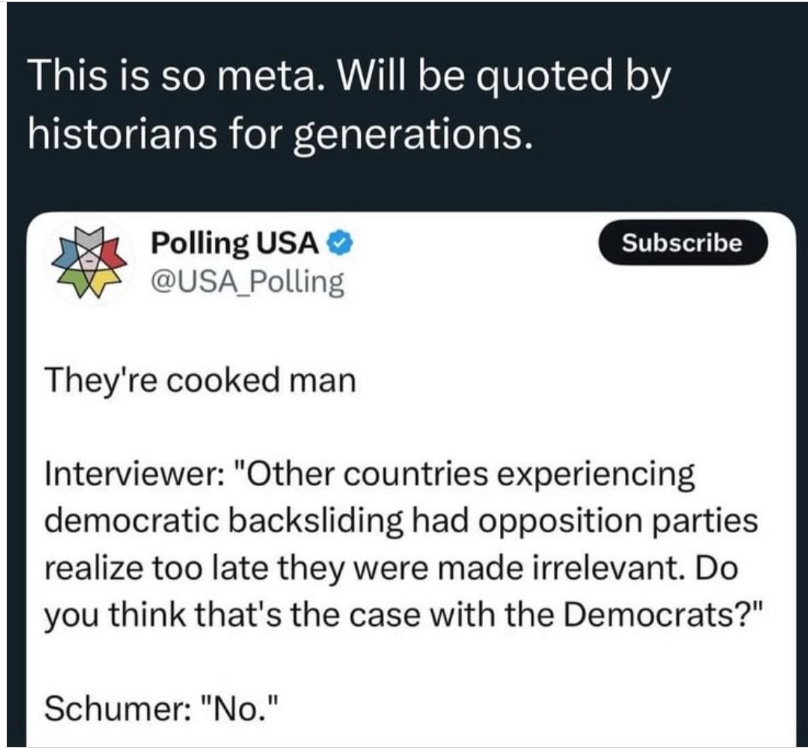
I keep coming back to a quote about the Roman Empire (I am one of those people who think about the Roman Empire once a week, but have the social awareness to keep my mouth shut about it): “One day the bridge broke, and no one came to fix it.”
The fall of an empire (particularly one that - bafflingly - willingly cedes global hegemony for the enrichment of a few) is not marked by single events. Sure, you could point at things like ICE executions, or the Israeli-American War on Iran, or the general population’s shrugging at things like the Panama Papers and the Epstein files that laid bare the profane debauchery of our ruling classes, as singular events that foretold the sunset of the American global power structure.
But Confucious was right when he said, “The man who moves a mountain begins by carrying away small stones.” The American empire is not one that can be undone in a single bound - we needed two Trump administrations with a feckless opposition party presidency in between to get to this path. That’s 12 years of descent via incremental damage - you can’t just pull the plane back up that quickly after something like that.
So next time something breaks - whether it’s the throwing out of the Constitutional power of Congress as the controller of the state purse and official war declaration, or cowardly law enforcement agents obscuring their identities as they murder civilians in the streets, or something as commercially critical to an advanced economy as quick and safe air travel - ask yourself if it’s actively being fixed. Or if the games being played in Washington and across state capitols are getting in the way of, you know, running the country.
Media of the Week
I’m not opposed to sci-fi (the Dune films were the first movies I watched on my new home theater setup), but one thing I tend to avoid is zombie and vampire movies. They just don’t quite do it for me and there’s so much quality content to watch with so little time that I tend not to gravitate towards them.
That said, Sinners broke that mold (at least for me.) After Michael B. Jordan’s Oscar I knew I was going to have to see it. Leo was great in Paul Thomas Anderson’s One Battle After Another, and Jordan and Coogler have made movie magic in the past, so I figured, why not? I was not disappointed.

A lot of folks said Jordan won the Oscar simply because he played dual roles - I don’t think that’s the case. His portrayal of Smoke or Stack singularly was cool, but the subtlety that he was able to weave into and between the two characters was what was most impressive and what I imagine the Academy appreciated.
We mentioned Leo earlier - the Coogler/Jordan pairing is beginning to look like the generational run that Scorsese/DiCaprio had, and are must-sees. But another, more subtle collaborator is with Ludwig Goransson, the Swedish-American composer who has been crushing Hollywood scores for the past few decades. His work with Childish Gambino is what first introduced me to Ludwig, but when you dig into his collaborations, you realize if Ludwig’s on something, it’s likely worth checking out. Particularly if it’s with Ryan Coogler.
Quote of the Week
“I fear the day that technology will surpass our human interaction. The world will have a generation of idiots.” - Unattributed
Usage of AI In This Post
The only times AI was used for this post was for the Clavicular tweet translation and the photos (which Claude is much worse at than ChatGPT.)
This newsletter canceled his Chat Premium for Claude Premium, in the naive belief that Anthropic is somehow less harmful of a company than OpenAI. Time will likely prove me wrong.
See you next time!