

Avoiding Pain Avoidance
Ego defense is a real blocker to growth at work.

There are a lot of idioms about facing down an obstacle known to be unpleasant. We’ve all been told “It’s time to face the music,” or “To grab the bull by the horns,” or “No risk, no reward.” While the sayings all have different contexts, the common idea of bracing oneself to face something that will be difficult and painful permeates throughout.
And these idioms exist because it is human nature to try to avoid pain. It’s a protective measure undertaken primarily by our ego - it sees pain and runs the other way as a way to protect its owner. The problem with this - particularly in modern society and modern workplaces - is that this pain is actually a source of growth in many instances.
Ego Defense
The theory of the ego acting as a protective body is rooted in Freuds’ work (both Sigmund and his daughter Anna.) Ego defense serves a purpose: there are legitimate things the ego needs to protect us from in terms of emotional pain. The id’s compulsive side needs to be managed, and the superego provides the kinds of guardrails that the ego must help to referee.
But so much of this exists in our subconsciouses that it creates internal conflict that we find difficult to pinpoint. This is where anxiety comes in - it results from the unresolved tension within our brains regarding a very particular set of triggers, or more generally, in our day-to-day. This can lead to the kind of pain avoidance that goes well beyond controlling our ids - it means we’re avoiding “clean pain” and instead replacing it with “dirty pain.”
No Risk, No Reward
We’ve explored the topic of how discomfort leads to growth. And how being uncomfortable all the time actually detracts from growth (shout out the Cynefin framework.) A similar axiom applies to pain avoidance.

This newsletter recently had a good example of this: the decision about whether or not to attend CES this year.
The easy (and least painful thing to do) would have been to decline. The factors against going to avoid pain were high: it’s the first full week of the year after the holidays, which not only tend to be stressful with elementary school children, but also smack in the middle of flu season. I’m already on a client that takes every ounce of my time and energy during the day (hence the decreased output here), and even though I could coordinate coverage, I’d still need to be present as a leader on the account. The stakes at CES would be high, given that my position has me in the lowest level of leadership, meaning events like this put me at the bottom of the totem pole in the hierarchy. Also, it’s a lot of socializing and networking - something an introvert like me has a limited capacity for, and Vegas would be a week-long commitment. I also hate crowds (ironic for a kid from the northeast who’s spent most of his adult life in Manhattan.)
In other words, my ego was asking me what the hell I was doing as I accepted the assignment. For weeks leading up to it I kept asking myself if I made a mistake. That was my ego trying to avoid the inevitable pain that awaited me once I deplaned at McCarran. But the pain I faced walking the convention halls, rubbing elbows with leaders who have a lot of control over my career, and being responsible for a highly visible webinar (check it out here!) was necessary for growth. Had I listened solely to my ego, I would have missed out on all of that.
Ego Defense Manifestation
The CES example is a pretty obvious and large one. Ego defense, however, is not always that obvious or high stakes.
Other ways it manifests is not putting your all into an assignment because presenting it or receiving feedback on it is something you’re subconsciously trying to avoid. By half-assing it and getting it off your list, you might think you’re minimizing the pain (as you’re spending less conscious time on it, where the pain source is obvious.) All this does is prolong the pain, as decreased productivity or lower-quality work product will lead to more pain down the line.

Another way employees tend to do this is with feedback. Often, we don’t seek it out, afraid of what we might hear. More damagingly, managers may avoid having difficult conversations with direct reports who need constructive, albeit negative, feedback. Avoiding the painful conversation may protect the manager in the short term, but it hurts both manager (with an underperforming employee) and employee (as they are unaware of where they need to focus and improve.)
The Facts of Life of the Ego
Ego defense is simply another reminder of how powerful our egos are, and how they need intentional oversight to ensure that their guidance and management between the id and the superego is being faithfully executed.

The ego is a powerful, but imperfect, ingrained part of our psyches, and we need to take the good with the bad. The problems a junior employee might experience with ego (more pain avoidance) evolve as one climbs up the corporate ladder (more hubris syndrome.) Throughout it all, this arbitrator between id and superego can be a very helpful tool if we can recognize it and shine some light into our opaque subconsciouses to ensure all three are playing fair - and guiding us in the right direction.
Grab Bag Sections
WTF Patriots: Look, they were underdogs heading into the game. The Seahawks were absolutely the better team on paper, but the Pats have been beating better teams on paper all year. They’re a young team, and there will be plenty more deep playoff runs for this crew (if they can stay out of prison), but this one stung.
They were dominated from the first drive through the final seconds. The run game never materialized (Bad Bunny had more turf under his feet than the Pats RBs) and the play calling for Maye’s air game (especially late in the game when urgency was paramount) had many scratching their heads.
This newsletter was exposed to some WEEI right after the game, and rest assured the blame will certainly be rooted out and attributed to anyone and everyone involved in Sunday’s Santa Clara Catastrophe, but the two obvious gaps in the Pats’ game was the offensive line (or complete lack thereof) and Drake Maye’s shoulder.
At least the cold snap seems to be breaking this week, undoubtedly catalyzed by the self-righteous anger of a fan base that - despite being spoiled for the past two and a half decades - have not quite shaken the feeling of victimhood from the 90s (this newsletter included.)
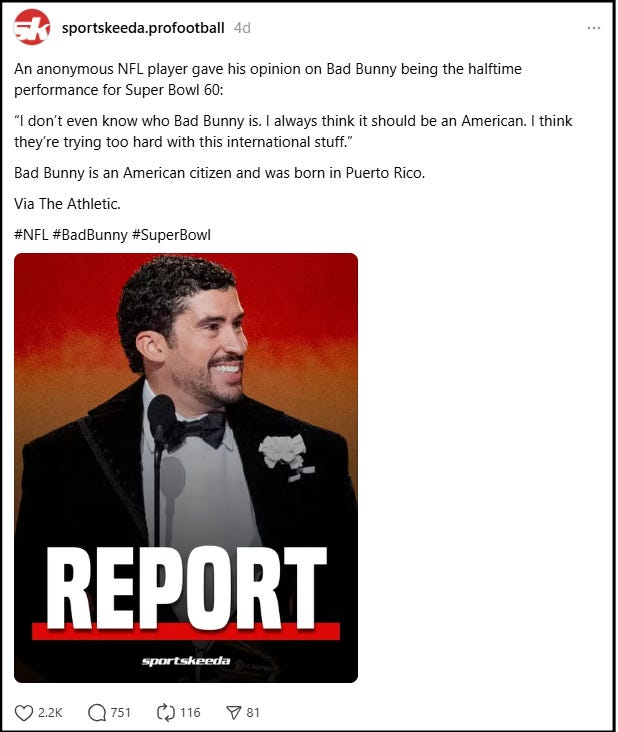
Media of the Week: There was a lot of chatter about Bad Bunny leading up to the Super Bowl. From a marketing perspective, it makes a lot of sense - for a sport that is looking to expand globally for that all-encompassing master known as growth, having a Spanish-speaking halftime performer makes a lot of sense (and the numbers certainly back that up.) And you could do a lot worse than Benito, who is having a moment culturally in the US, even if many of his detractors (including NFL players themselves) have a tough time understanding Puerto Rico’s relationship with the United States.
But the culture wars lost as much as Bad Bunny won, trotting out a veritable who’s who of Latino actors dancing in front of a casita and two prominent features in Lady Gaga and fellow boricua Ricky Martin, ending the performance on an undeniable unity message that our so-called leaders in Washington have a tough time mustering.
Do you need to speak Spanish to enjoy this halftime show? No - the thing about performances and music is that sometimes it can be just vibes. Good performers (and Bad Bunny certainly falls into this category) are able to portray their art and emotions regardless of the tongue being used.
The final piece this newsletter appreciated about the show was that Bad Bunny was putting people on - many small businesses and local groups were featured throughout the performance. We might need to change the name of a certain post on this newsletter to Envía el Ascensor de Vuelta Hacia Abajo.
Quote of the Week: “The personal ego already has a strong element of dysfunction, but the collective ego is, frequently, even more dysfunctional, to the point of absolute insanity.” - Eckhart Tolle
AI Usage in This Post
The only AI used for this post was ChatGPT (don’t worry, I unsubscribed from the premium version) to help distill Anna Freud’s seminal Ego and the Mechanisms of Defense and also as a quick refresher on the id, ego, and superego and their intertwined relationship.
See you next time!
MK - I find your writing about the inevitability and utility of pain quite interesting. In recent years, I’ve dipped my toe into the practice of Mindfulness Meditation, particularly enjoying the readings of Eckhart Tolle, Jon Kabat Zinn, and Dan Harris. While it appears you’ve done a thorough dive re: our primitive instinct to avoid discomfort, it wasn’t until recent years that I learned how important confronting pain is in terms of personal development. Indeed, growth requires friction.
I had teacher once explain the difference between pain and suffering. And he described that while pain is a surefire, intrinsic part of life, suffering occurs solely when we make a conscience choice to resist the pain. When I first heard this, it struck me as such a transparent, unmmistakable law of psychiatry that shame nearly overtook me. How much of my 20’s (fine, maybe early 30’s) had I spent misgidedly chasing away pain, using all the usual tricks. And why had I been so eager to make the tradeoff for suffering over pain?
Like with most other things worthwhile, there are no shortcuts. I’m on my third year of a near-daily Mindfulness Meditation and while I’m certainly no Tolle or Kabat Zinn, I’ve learned to not only embrace the pain but use it to continue to grow. - Chappell